

Key takeaways
- Card type, print run, autograph and memorabilia describe different features.
- The same player and card number can appear in several parallel versions.
- Read the back of the card as well as the name on the listing.
Open contents
Start with base, insert and RC
Base cards form the regular, core checklist of a product. Inserts are separate groups of cards built around a theme or a distinct design. That theme might celebrate a player’s style, achievements or nickname, giving collectors another way to follow their favorites.
RC stands for rookie card. It is a useful term when looking for cards from the beginning of a player’s career, but not every card depicting a young player has the same status. Check the product, release year and any rookie logo together.
Base and insert describe a card’s place in a product. RC describes its connection to a player’s rookie season. Those labels can overlap: a rookie can have both a base card and an insert.
A parallel is another version of a corresponding card
A parallel changes features such as the color, pattern or finish of a corresponding card. Silver, Gold and Red are familiar examples. Inserts can have parallels too, so an insert and a parallel are not mutually exclusive categories.
The Luka Dončić cards below are both 2018 Panini Prizm #280. The Base and Silver Prizm versions have different surface finishes even though the player and number match. Read the full parallel name before treating two listings as the same version.
Paper is commonly used for traditional paper-based cards, while Topps Chrome cards have a metallic-looking finish. Refractor is a Topps name for a finish that changes color in the light. Prizm appears in Panini product and card-variation names. Use the manufacturer’s exact wording when searching, rather than treating every shiny card as the same finish.
A photo variation uses a different photograph of the player. It offers a different pose or moment instead of simply another color. A different image alone does not tell you the print run; look at the product’s specifications if rarity matters to you.
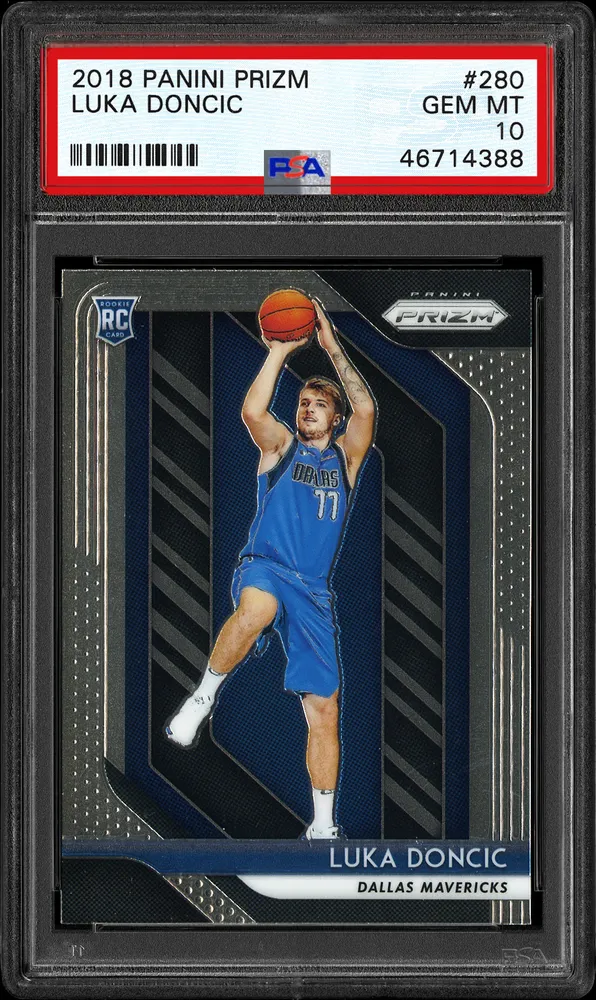
#280 / BaseView details & price history
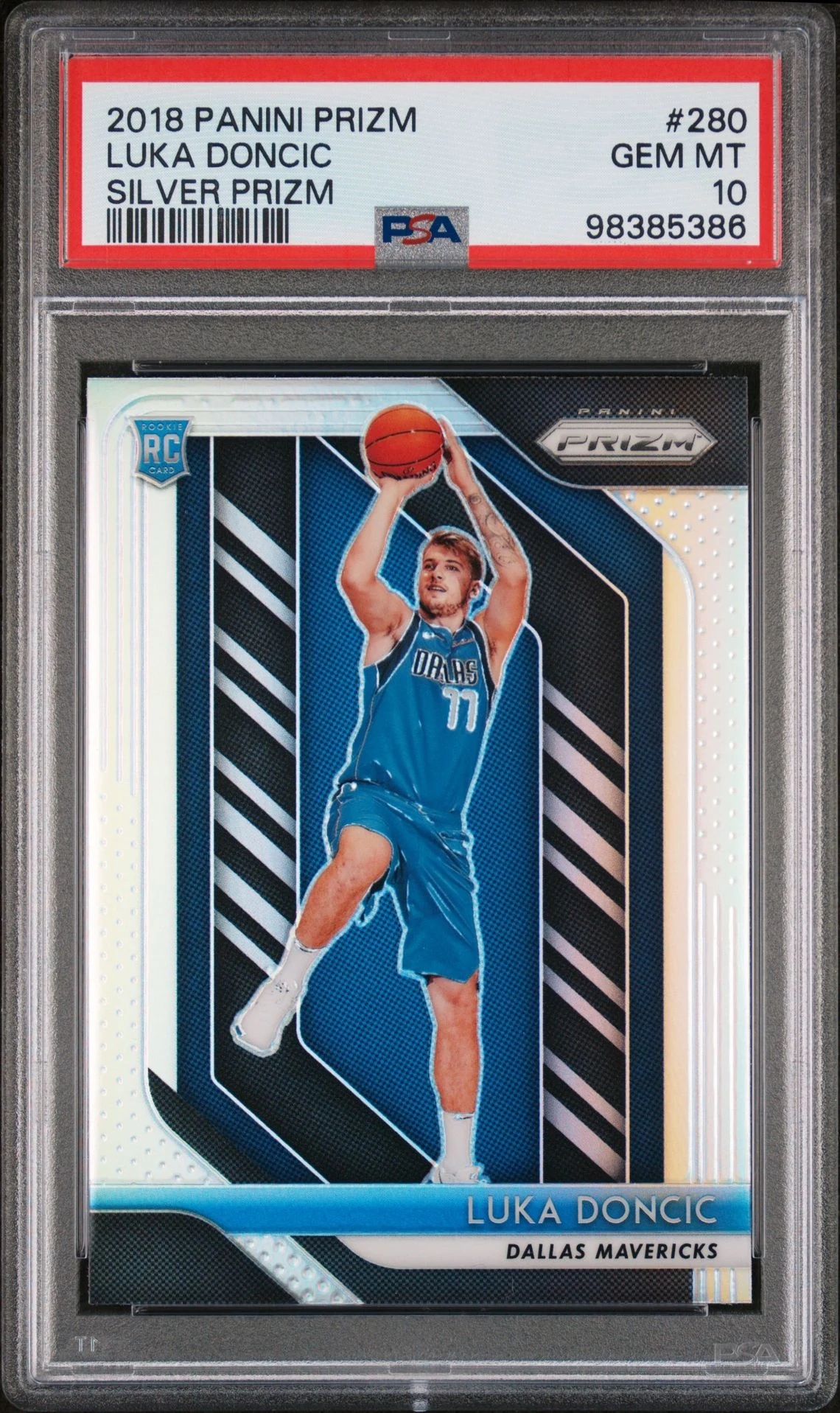
#280 / Silver PrizmView details & price history
/99 and SP communicate scarcity in different ways
A stamp such as 12/99 means that this particular version has a print run of 99, and this is copy number 12. The denominator is the print run; the numerator identifies the individual copy. Neither is the checklist number, such as #280, and /99 does not mean 99 copies are currently for sale.
A 1/1, or one of one, is the only copy of that exact version. It does not mean the player has only one card in existence. Other colors or designs may have their own 1/1s. Collectors sometimes use informal labels for very low-numbered cards, but there is no universal cutoff.
SP means short print: a card produced in smaller quantities than regular cards in the same product. SSP, or super short print, signals a still shorter print run. Neither term gives a universal copy count, and an SP does not have to carry a serial-number stamp.
The Cooper Flagg card below combines an autograph, a Gold Refractor finish and a /50 print run. These are separate attributes that can all appear in the name of one card.
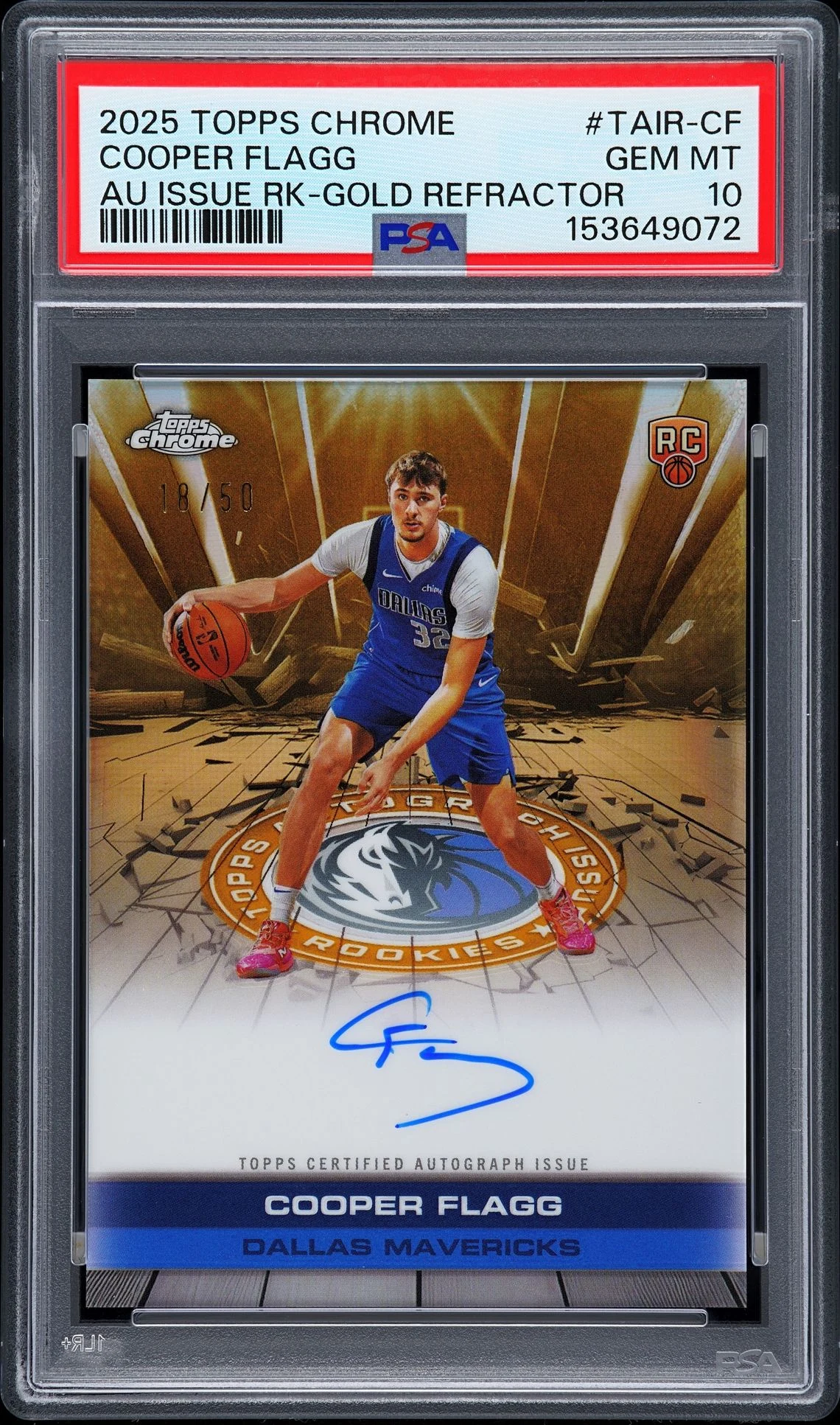
Auto means autograph. Where it is signed matters too
Auto is short for autograph. An on-card auto is signed directly on the card itself. A sticker auto uses a label signed by the player and then attached to the card. A sticker autograph is not simply a printed reproduction of a signature.
Some collectors prefer the way an on-card signature fits the design; others focus on the signature’s legibility or the overall composition. Look at the signing method and the certification on the back, as well as the presence of the autograph, to decide what appeals to you.
Jersey and patch describe material; game-used describes its history
Memorabilia and relic are terms used for cards containing pieces of material, such as a uniform. Jersey generally refers to a piece of fabric. Patch often refers to a decorative area such as a logo, lettering or number. The colors and embroidery can make individual cards look quite different.
Separate what the material looks like from how it was used. Game-used describes material used in a game; player-worn describes material worn by a player. Being worn by a player does not by itself establish game use, and a patch is not automatically a game-used patch.
A statement that material is not associated with a specific game or event does not, by itself, rule out player wear. Read the complete certification to see whose material it is and what use or wear is actually stated. A large logo or an impressive tag cannot answer those questions on its own.
A redemption is a claim for a finished card
A redemption is inserted into a pack in place of a finished card. Autograph redemptions are a familiar example. The collector submits the code through the manufacturer’s specified process and follows the instructions for fulfillment.
If a listing shows a redemption, establish whether the seller is offering the redemption itself or the finished card obtained from it. Codes can only be used once, so unused status matters. Expiration dates, acceptance rules, replacements and fulfillment times vary by manufacturer and product.
How packs, boxes, cases and case hits fit together

A pack is an individual wrapper containing cards. A box is a sales unit containing packs or cards, and a case groups multiple boxes. Quantities vary by product; some boxes contain just one pack.
Case hit is a hobby term for a card with low enough insertion odds that it is discussed at the case level. The label alone does not guarantee one in every case. Read stated odds separately from any explicit guarantee printed on the product.
Opening a box lets you explore a product’s mix of cards. Buying a single lets you choose a specific card. Understanding the product’s contents makes it easier to decide which way of collecting suits you.
Read a long listing title one piece at a time
Take the fictional title “20XX Example Basketball #123 Gold /99 On-card Auto.” Gold names the version, /99 gives that version’s print run, and On-card Auto describes a signature written directly on the card. Each term contributes a different piece of information.
You do not need to memorize everything at once. Start with a card of a player you like. Compare it with the regular version and read the back. Once the words connect to features you can see, it becomes easier to recognize the colors, designs and versions you want to collect.
- Is it part of the base set or an insert set, and which parallel, if any?
- Have you distinguished the checklist number from the serial number?
- What signing method or memorabilia description is given?
- Do the photographs, listing title and back-of-card text match?